

JSTAMP

JSTAMP
Hot stamping
- Manufacturing trends
Hot stamping is a forming method that reduces springback. The process involved is as follows: preheat a sheet material up to austenite temperature first; then perform hot forming followed by tempering with rapid cooling to obtain a high-strength sheet panel.
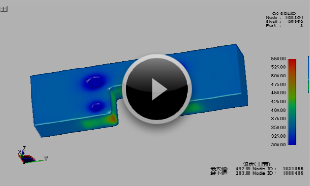
JSTAMP can consider temperature dependency of the material and heat transfer to the mold by using thermal-structural interaction analysis.
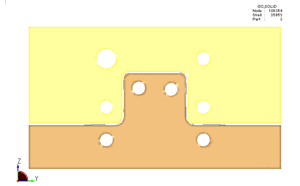
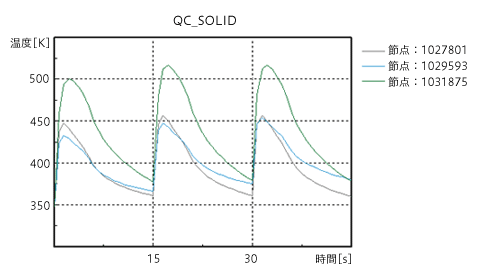
A tool model built with solid elements can be used to evaluate the temperature distribution history during multishot.
Hot stamping of B-pillar
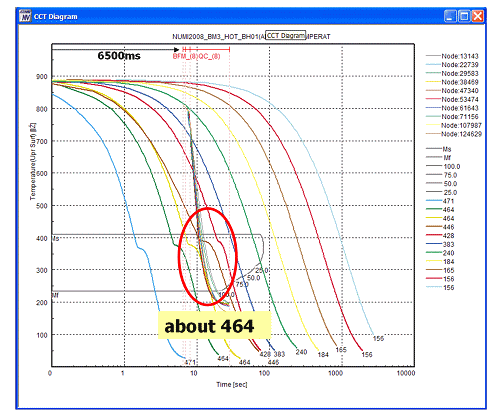
This example involves a hot stamping simulation using the Benchmark test model 3 (BM3) presented at the Numisheet 2008 international conference. JSTAMP can animate changes in the temperature distribution. The Continuous Cooling Transformation (CCT) diagram evaluation feature, which predicts quenching at a given location in the model based on Vickers hardness, is useful as well. In this example, the predicted Vickers hardness was 464, which agrees with the experimental result.



Tool temperature history during multishot
A tool model built with solid elements can be used to evaluate the temperature distribution history during multishot.