

J-Composites

J-Composites
Predicting wrinkles during forming of a 3K plain dry fabric material
- Simulation result accurately represents fine wrinkling during press forming
Effect of fiber direction on forming result
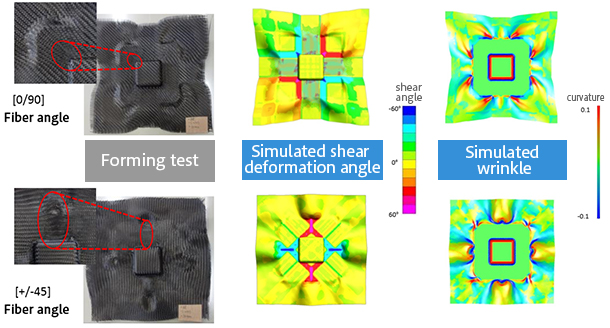
To evaluate the accuracy of the simulated result, a square cup drawing test of a single-layered CF dry fabric is performed with different fiber directions.
- Composite: CF dry fabric
- Lamination structure: Single layer
- Fiber direction[0°/90°] (top) vs. [+/-45°] (bottom)
- Evaluation item: Shear deformation angle, wrinkle location
Good consistency between the simulation result and the actual test was confirmed with the simulation reproducing the differences in forming behavior depending on the fiber direction.
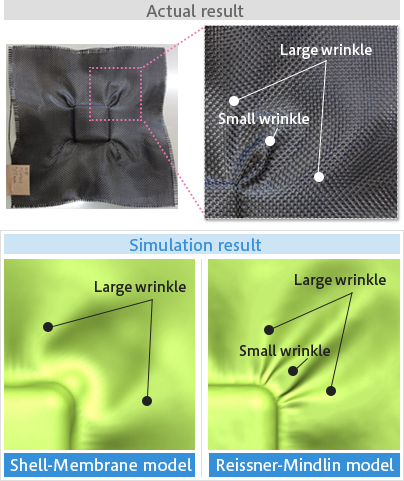
Reproducing fine wrinkling with different modeling methods
Stopping forming in mid-stroke, we can observe how wrinkles are formed. The result shows that accounting for out-of-plane shear deformation enables the Reissner-Mindlin shell theory based model to represent wrinkles with a small wavelength more accurately.