


A tool to set up composite material analysis
J-Composites

A tool to set up composite material analysis
J-Composites
Compression molding simulation with lattice-rib geometry
One of the goals of CAE is to reduce development cost by applying CAE in the product design phase. This case study evaluates the suitability of this analysis method by performing compression molding simulation with a more complex geometry.
Use Cases Highlights
- Fiber reinforced material compression forming analysis
- Reduce costs and time
- Can also evaluate forming conditions involving large deformation
Learn more about material used for solution
"In this case study, the forming material is discontinuous long-fiber reinforced plastic called Randomly-Oriented Strands (ROS).
Material: Flexcarbon® (SUNCORONA ODA)
Carbon fiber length: 25mm
Strand orientation 2D Random orientation
Fiber volume content (VF): 40%
Matrix resin: Thermoplastic resin epoxy"
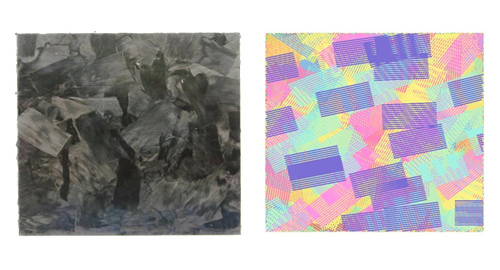
ROS type discontinuous long-fiber reinforced plastic: Actual material (left), Simulation model (right)
Result
To evaluate the applicability to a complex geometry, compression molding simulation of a hat shaped part with a lattice-rib geometry (8 in longitudinal direction and 1 in width direction) was performed. The simulation reached successful termination, which indicates that molding behavior can be evaluated even for such complex geometry.
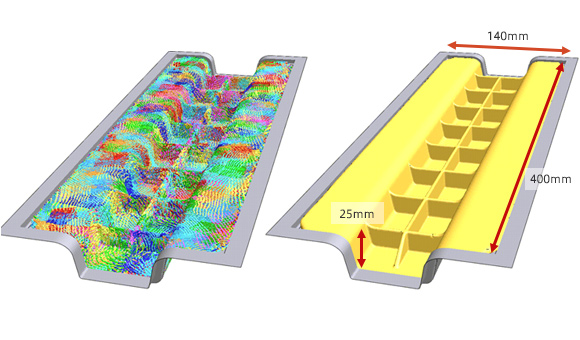
Deformed geometry of fiber (beam) and matrix resin (solid)
