


Multiscale Modeling and Simulation Platform for Materials and Life Sciences
J-OCTA

Multiscale Modeling and Simulation Platform for Materials and Life Sciences
J-OCTA
Glass Transition Temperature Evaluation
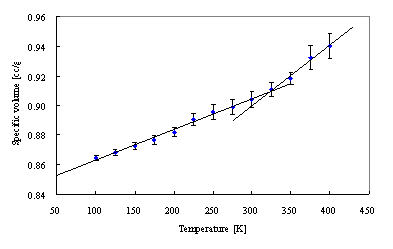
Full-Atomistic Molecular Dynamics (FAMD) was used to evaluate the glass transition temperature (Tg) of polymers. Cooling operations (quenching) were performed by lowering temperature stepwise from high temperature, and Tg was determined from the inflection point of specific volume changes. Multiple polymers were tested and compared with experimental values.
Use Cases Highlights
- Analysis of specific volume changes by quench calculations
- Evaluation of glass transition temperature from the inflection point of specific volume change
- Comparison with experimental Tg values for each substance
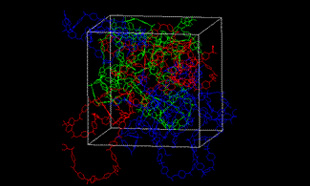
Creation of amorphous structures
Amorphous structures of polymers created using a United Atom model with J-OCTA’s amorphous structure builder are shown. Temperature is changed stepwise for continuous calculations.
Amorphous structure of polycarbonate
Evaluation of glass transition temperature from the inflection point of specific volume change
As an example, changes in the specific volume (inverse of density) of polyethylene with temperature are shown. A distinct inflection point appears on the graph, and the temperature at this point is evaluated as the glass transition temperature.
Specific volume change of polyethylene
Comparison with experimental Tg values for each substance
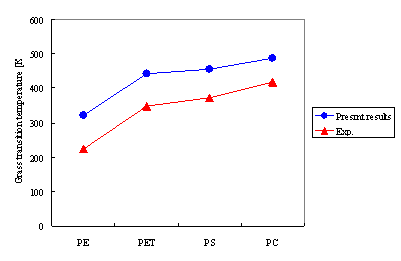
The Tg values of polyethylene (PE), polyethylene terephthalate (PET), polystyrene (PS), and polycarbonate (PC) were calculated and compared with experimental values. Although Tg was overestimated due to high quench rate, the material-dependent trends matched experiments, enabling qualitative evaluation.
Comparison of Tg for each material
Reference
[1] Extracts from Polyinfo Database
Details of analysis
Inquiries Regarding Products
Have questions about product implementation? Contact us today.
Related Information
Solutions

Materials Simulation and Materials Informatics (Automotive)
Materials development through the integration of simulation and data science (Materials DX)

Materials Simulation and Materials Informatics (Mobility)
Materials development through the integration of simulation and data science (Materials DX)
Materials Simulation and Materials Informatics (Electrical Equipment/Precision Equipment/Semiconductors/Heavy Electrical Equipment)
Materials development through the integration of simulation and data science (Materials DX)