


Multiscale Modeling and Simulation Platform for Materials and Life Sciences
J-OCTA

Multiscale Modeling and Simulation Platform for Materials and Life Sciences
J-OCTA
Uniaxial Elongation and Craze Growth in Glassy Polymers
Coarse-Grained Molecular Dynamics (CGMD) simulations were conducted to model the fracture behavior of amorphous polymers under uniaxial extension. For two systems with different molecular weights, void formation and fibril formation were compared, and differences in post-yield stress behavior were evaluated from stress–strain curves. Calculations using the Kremer–Grest model, a type of Coarse-Grained MD, clearly demonstrated the influence of molecular weight.
Use Cases Highlights
- Evaluation of craze formation behavior
- Evaluation of differences in behavior due to molecular weight
- Evaluation of universal behavior using the Kremer–Grest model
Craze growth during deformation
Evaluation of craze growth in amorphous polymer materials using the Kremer–Grest Coarse-Grained model is shown. Molecular weight N = 128 is used, and void formation and early fibril formation are observed.
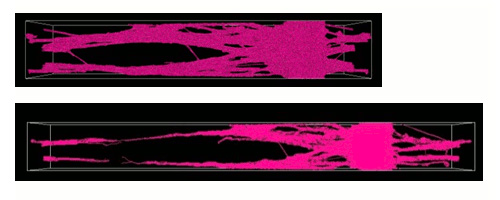
Craze growth (N=128)
Craze growth in polymers with increased molecular weight
Snapshots of craze growth in a polymer chain with molecular weight N = 512 are shown. Fibril formation progresses, leading to more complex structures. Differences in structure formation due to molecular weight are clearly demonstrated.
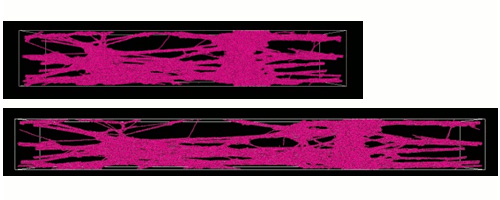
Craze growth (N = 512)
Stress–strain properties
In the N=128 case, stress decreases after yielding, while in the N=512 case, stress increases after fibril formation. The qualitative effect of molecular weight differences on mechanical response was evaluated.
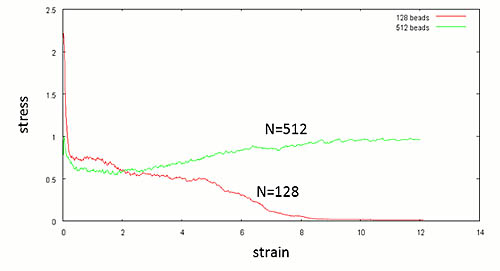
Stress–strain curve
Reference
[1] Physical Review E, 68, 011801, (2003)
Details of analysis
Related information
Inquiries Regarding Products
Have questions about product implementation? Contact us today.
Related Information
Solutions

Materials Simulation and Materials Informatics (Automotive)
Materials development through the integration of simulation and data science (Materials DX)

Materials Simulation and Materials Informatics (Mobility)
Materials development through the integration of simulation and data science (Materials DX)

Materials Simulation and Materials Informatics (Electrical Equipment/Precision Equipment/Semiconductors/Heavy Electrical Equipment)
Materials development through the integration of simulation and data science (Materials DX)