


Multiscale Modeling and Simulation Platform for Materials and Life Sciences
J-OCTA

Multiscale Modeling and Simulation Platform for Materials and Life Sciences
J-OCTA
Phase-separated structure of polyelectrolyte using FMO-DPD
The FMO-DPD method was used to predict the structure of polymer electrolyte membranes for fuel cells. The χ parameters, representing component interactions, were estimated using FCEWS based on the Fragment Molecular Orbital (FMO) method, and the phase-separated structures of water and polymers were analyzed by Dissipative Particle Dynamics (DPD). The channel structures formed by electrolytes with hydrophobic backbones and hydrophilic side chains in water were reproduced, showing trends consistent with experiments.
Use Cases Highlights
- Prediction of χ parameters using FCEWS and mesoscale analysis of polymer electrolytes for fuel cells
- Method useful for fuel cell design
Prediction of χ parameters using FCEWS and mesoscale analysis of polymer electrolytes for fuel cells
A polymer electrolyte is segmented, and χ parameters between segments are predicted with high accuracy using FCEWS based on the Fragment Molecular Orbital (FMO) method. Four water molecules are represented as one DPD particle.
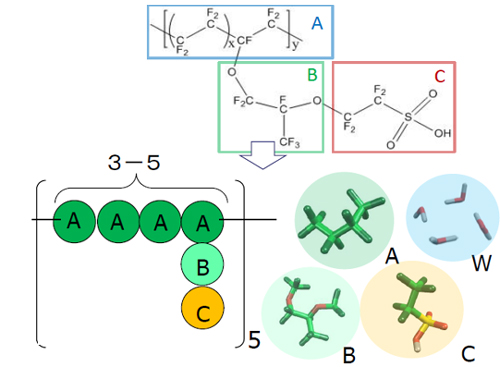
Segment division of polymer electrolytes
Method useful for fuel cell design
The phase-separated structure of a polyelectrolyte simulated using Dissipative Particle Dynamics (DPD) is shown. Different polymer components are separated at the mesoscale, forming nano-phase structures, which is important information for material design in applications such as fuel cells.
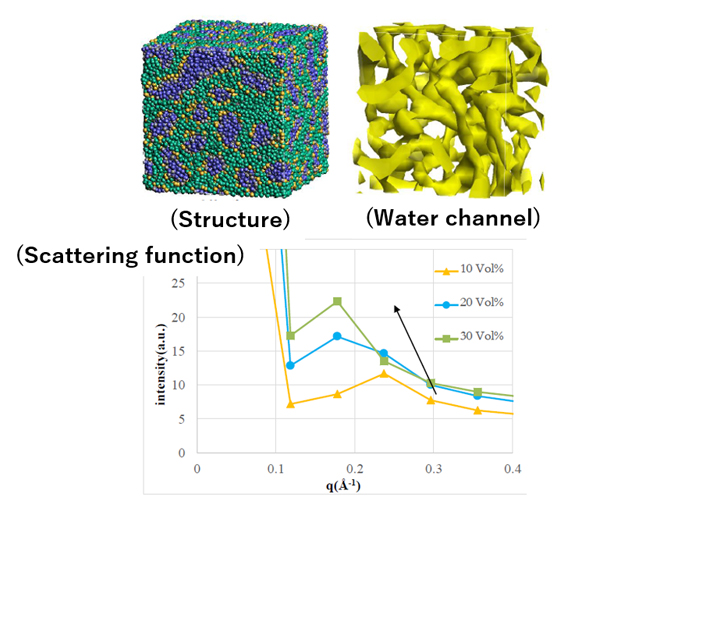
Phase-separated structure of polyelectrolytes obtained by DPD, including analysis of degree of phase separation and domain size as indicators for clarifying structure–function relationships in materials
Reference
[1] RSC Adv., 8, pp34582-34595, (2018)
[2] J.Phys.Chem.B, 122, pp338-347, (2018)
[2] J.Phys.Chem.B, 122, pp338-347, (2018)
Details of analysis
Inquiries Regarding Products
Have questions about product implementation? Contact us today.
Related Information
Solutions

Materials Simulation and Materials Informatics (Automotive)
Materials development through the integration of simulation and data science (Materials DX)

Materials Simulation and Materials Informatics (Mobility)
Materials development through the integration of simulation and data science (Materials DX)

Materials Simulation and Materials Informatics (Electrical Equipment/Precision Equipment/Semiconductors/Heavy Electrical Equipment)
Materials development through the integration of simulation and data science (Materials DX)