


Multiscale Modeling and Simulation Platform for Materials and Life Sciences
J-OCTA

Multiscale Modeling and Simulation Platform for Materials and Life Sciences
J-OCTA
Simulation of Solvent Evaporation Using DPD
COGNAC Dissipative Particle Dynamics (DPD) was used to represent two polymers, a solvent, and a gas phase. The evaporation phenomenon, in which the solvent component moves from a thin film composed of polymer and solvent to the gas phase region, was reproduced. The process of forming phase-separated structures transitioning from parallel to perpendicular orientation relative to the substrate during evaporation was confirmed, and the effects of interactions and wettability were evaluated.
Use Cases Highlights
- Evaluation of phase-separated structures with evaporation using DPD
- Evaluation of effects of evaporation rate and wettability
- Evaluation of phase separation in polymer thin films
Formation process of phase-separated structures during evaporation
The process in which two initially mixed polymers phase-separate during evaporation, first forming a parallel structure to the substrate and finally changing to a perpendicular structure, is shown.
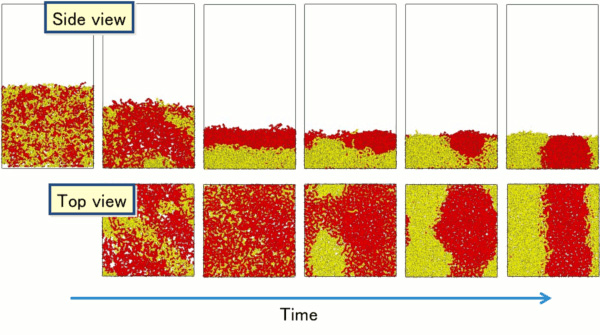
Phase separation in polymer thin films caused by solvent evaporation
Reference
[1] Nihon Reoroji Gakkaishi, Vol.36, 93-98
https://www.jstage.jst.go.jp/article/rheology/36/2/36_2_93/_pdf
https://www.jstage.jst.go.jp/article/rheology/36/2/36_2_93/_pdf
Details of analysis
Inquiries Regarding Products
Have questions about product implementation? Contact us today.
Related Information
Solutions

Materials Simulation and Materials Informatics (Automotive)
Materials development through the integration of simulation and data science (Materials DX)

Materials Simulation and Materials Informatics (Mobility)
Materials development through the integration of simulation and data science (Materials DX)

Materials Simulation and Materials Informatics (Electrical Equipment/Precision Equipment/Semiconductors/Heavy Electrical Equipment)
Materials development through the integration of simulation and data science (Materials DX)