


Multiscale Modeling and Simulation Platform for Materials and Life Sciences
J-OCTA

Multiscale Modeling and Simulation Platform for Materials and Life Sciences
J-OCTA
Machine Learning QSPR and Materials Informatics
J-OCTA’s MI-Suite features a QSPR (Quantitative Structure–Property Relationship) function for predicting the relationship between molecular structure and physical properties using machine learning. Descriptors are extracted from molecular structures described in SMILES notation, and methods such as graph convolutional networks (GCNs) are used to predict properties including density, glass transition temperature, and dielectric constant. All operations can be executed in Python scripts, from modeling and data generation to training and prediction. In addition to pre-trained models, users can build their own QSPR models using their own property data, enabling flexible property prediction tailored to specific objectives and contributing to efficient materials development.
Use Cases Highlights
- Structure–property correlation using deep learning
- Construction of predictive models using molecular structure information (SMILES) as input
- Improvement of generalization performance through machine learning
Structure–property correlation analysis using deep learning
An automated workflow from molecular modeling to property prediction using J-OCTA’s modeling API is shown. Python scripts allow efficient generation of large datasets.
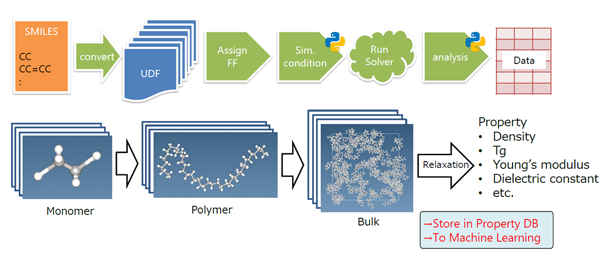
Automation of molecular modeling and property prediction using Modeling API
Construction of predictive models using molecular structure information (SMILES) as input
The concept of machine learning-based QSPR and a structure–property correlation learning model are shown. Molecular descriptors are used to predict property values, and training is performed using neural networks.
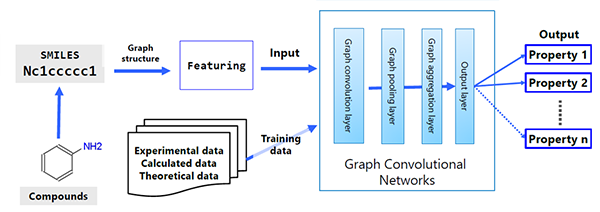
Construction of structure–property correlation model using machine learning QSPR
Improvement of generalization performance by machine learning
The density prediction results of amorphous polymers are shown. The left shows machine learning QSPR predictions, and the right shows predictions by the conventional Bicerano method, indicating that machine learning correlates more strongly with experimental values.
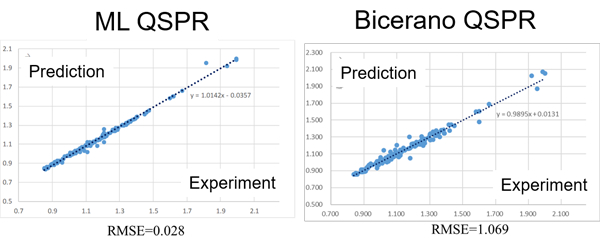
Comparison of density prediction results between machine learning QSPR and conventional QSPR (Bicerano method)
Details of analysis
Inquiries Regarding Products
Have questions about product implementation? Contact us today.
Related Information
Solutions

Materials Simulation and Materials Informatics (Automotive)
Materials development through the integration of simulation and data science (Materials DX)

Materials Simulation and Materials Informatics (Mobility)
Materials development through the integration of simulation and data science (Materials DX)

Materials Simulation and Materials Informatics (Electrical Equipment/Precision Equipment/Semiconductors/Heavy Electrical Equipment)
Materials development through the integration of simulation and data science (Materials DX)