

J-OCTA

J-OCTA
Construction of amorphous structure using reverse mapping
- Efficient creation of relaxed structures for long-chain polymer models
- Consideration of characteristic structural parameters of polymers
- Capability to create more ideal structures compared with conventional methods
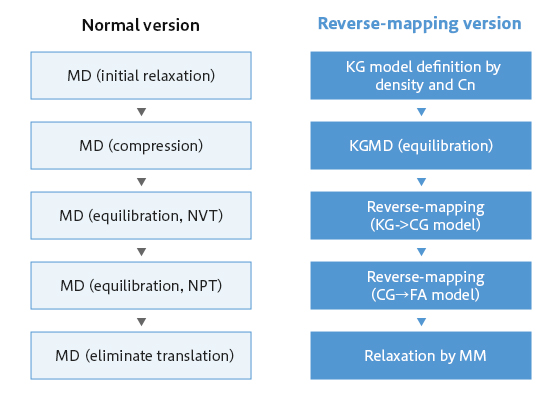
Efficient creation of relaxed structures for long-chain polymer models
A comparison of amorphous structure creation flows between the conventional method and the reverse-mapping method is shown. The conventional method involves compression from a dilute state, whereas the reverse-mapping method uses a Coarse-Grained model for efficient equilibration followed by conversion to a Full-Atomistic model.
Consideration of characteristic structural parameters of polymers
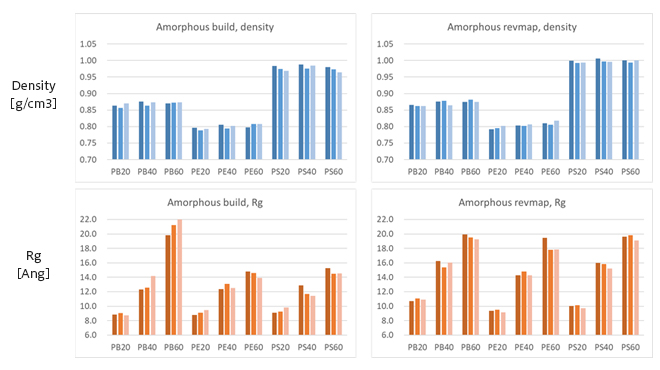
A comparison of density and radius of gyration (Rg) for three types of polymers—polyethylene (PE), polybutadiene (PB), and polystyrene (PS)—is shown. While densities are similar between both methods, differences in Rg become more pronounced as the degree of polymerization increases.
Capability to create more ideal structures compared with conventional methods
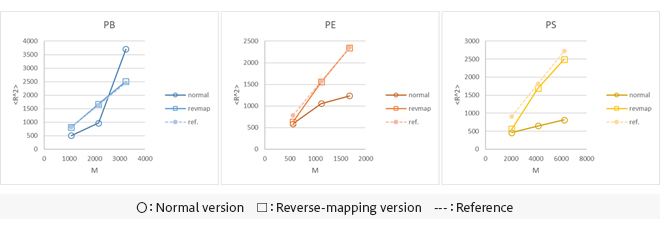
The degree-of-polymerization dependence of the mean-squared end-to-end distance for PB, PE, and PS models is shown. The reverse-mapped version yielded trends close to the theoretical proportional relationship, confirming the structural validity.
[2] H. Nitta, T. Ozawa and K. Yasuoka, J. Chem. Phys., 159, 194903 (2023).
Related Information
Solutions