


Multiscale Modeling and Simulation Platform for Materials and Life Sciences
J-OCTA

Multiscale Modeling and Simulation Platform for Materials and Life Sciences
J-OCTA
Conversion from relaxation modulus to dynamic modulus
J-OCTA includes several methods for calculating viscoelastic master curves from relaxation modulus data obtained in simulations. Here, i-Rheo GT was used to calculate G′ and G″ from Molecular Dynamics results, applying the time–temperature superposition principle to obtain properties over a wide frequency range. As verification, it was applied to viscoelastic solids and results from Coarse-Grained MD of polymers, showing good agreement with theoretical values. i-Rheo GT can be operated easily from the GUI, making it an effective tool for understanding and designing the viscoelastic properties of polymer materials.
Use Cases Highlights
- Conversion of relaxation modulus to dynamic modulus
- Applicable to analysis of various materials
- Also useful for analysis of experimental results
Conversion of relaxation modulus to dynamic modulus
Results of applying the i-Rheo GT method to a viscoelastic solid are shown. While FFT shows errors at low frequencies, i-Rheo GT agrees well with theoretical solutions.
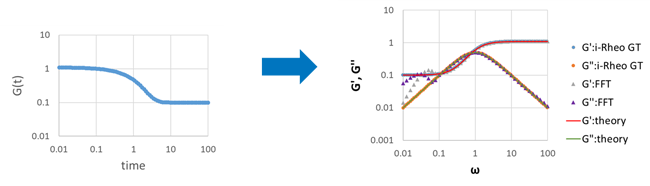
Application to viscoelastic solids
Applicable to the analysis of various materials
The results of evaluating a viscoelastic master curve using the relaxation modulus G(t) obtained from Coarse-Grained Molecular Dynamics (CGMD) with the Kremer–Grest model are shown. The results from FFT and i-Rheo GT are in good agreement, confirming the effectiveness of the method.
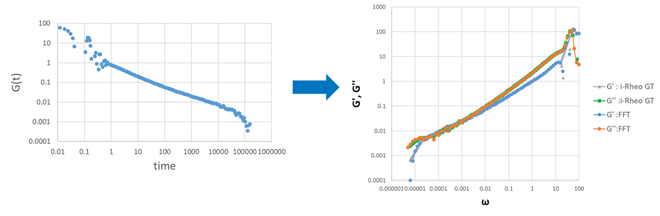
Evaluation of viscoelastic master curve using relaxation modulus obtained from Coarse-Grained Molecular Dynamics (CGMD)
Useful for analysis of experimental results as well
An overview of the linkage between i-Rheo GT and J-OCTA is shown. By passing simulation results from J-OCTA to i-Rheo GT, viscoelastic properties can be quickly evaluated, and the linkage flow is visually explained.
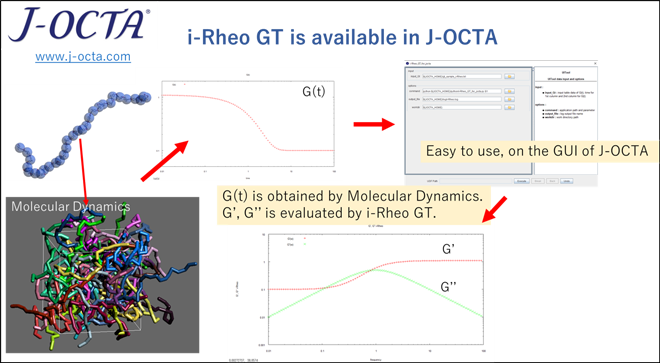
Overview diagram of linkage between i-Rheo GT and J-OCTA
Reference
[1] M. Tassieri, et al., Macromolecules 51, 14, 5055-5068 (2018)
[2] M. Tassieri, et al., Journal of Rheology 60, 649 (2016) (2016's most read article in the Journal of Rheology)
[2] M. Tassieri, et al., Journal of Rheology 60, 649 (2016) (2016's most read article in the Journal of Rheology)
Details of analysis
Inquiries Regarding Products
Have questions about product implementation? Contact us today.
Related Information
Solutions

Materials Simulation and Materials Informatics (Automotive)
Materials development through the integration of simulation and data science (Materials DX)

Materials Simulation and Materials Informatics (Mobility)
Materials development through the integration of simulation and data science (Materials DX)

Materials Simulation and Materials Informatics (Electrical Equipment/Precision Equipment/Semiconductors/Heavy Electrical Equipment)
Materials development through the integration of simulation and data science (Materials DX)