


Multiscale Modeling and Simulation Platform for Materials and Life Sciences
J-OCTA

Multiscale Modeling and Simulation Platform for Materials and Life Sciences
J-OCTA
Simulation of heat transfer in fiber oriented material using VSOP-PS
The particle method engine VSOP-PS was used to analyze the thermal conductivity of fiber-oriented composite materials. Significant differences in thermal conductivity depending on fiber orientation were confirmed, and similar trends were obtained when compared with Digimat-MF.
Use Cases Highlights
- Creation of fiber orientation structures and evaluation of thermal conductivity using the particle method
- Analysis of the effect of fiber orientation
Creation of fiber-oriented structures and evaluation of thermal conductivity using the particle method
A fiber orientation model created using a particle method is shown. Fibers are placed as particles within a matrix, and shear flow is applied to form an oriented structure. Fibers are modeled as rigid while reproducing a slightly curved shape.
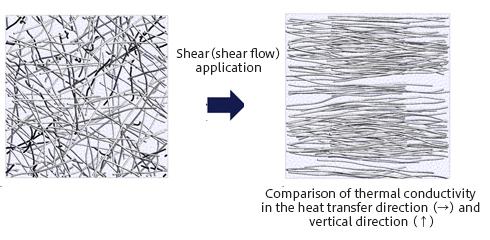
Modeling of fiber orientation structures using particle method
Analysis of the effect of fiber orientation
A comparison of thermal conductivity when fibers are oriented in the heat conduction direction (0°) and perpendicular (90°) is shown. When oriented in the heat conduction direction, thermal conductivity is about three times higher than in the perpendicular direction, indicating a significant effect of orientation.
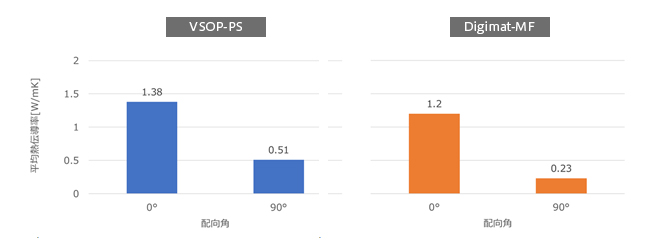
Difference in thermal conductivity depending on orientation direction (VSOP-PS calculation results)
Reference
[1] (in Japanese) https://www.tus.ac.jp/today/archive/20220926_3581.html
[2] (in Japanese) https://www.kri-inc.jp/tech/1273742_11451.html
[3] Digimat-MF
[2] (in Japanese) https://www.kri-inc.jp/tech/1273742_11451.html
[3] Digimat-MF
Details of analysis
Inquiries Regarding Products
Have questions about product implementation? Contact us today.
Related Information
Solutions
Materials Simulation and Materials Informatics (Automotive)
Materials development through the integration of simulation and data science (Materials DX)
Materials Simulation and Materials Informatics (Mobility)
Materials development through the integration of simulation and data science (Materials DX)
Materials Simulation and Materials Informatics (Electrical Equipment/Precision Equipment/Semiconductors/Heavy Electrical Equipment)
Materials development through the integration of simulation and data science (Materials DX)