


Fine-Particle and Pigment Dispersion: The Role of Simulation


1. Fine-Particle Dispersion in Liquids
The performance of paints and inks is strongly influenced by how finely pigments and functional particles are dispersed in a liquid, how uniformly that dispersed state is maintained, and how effectively re-agglomeration is suppressed over time. A useful way to understand liquid-phase dispersion is to view it as three closely connected stages: wetting the powder, breaking down agglomerates, and stabilizing the dispersed state [1]. In practical formulation work, these stages should be considered as parts of a continuous process rather than as independent tasks.
The first stage is to ensure that the liquid thoroughly wets the surface of the dry powder and penetrates into the voids within agglomerates. Organic pigments, in particular, can sometimes be difficult to wet using the dispersion medium alone. In such cases, surfactants or wetting agents may be used to improve liquid penetration. Wetting and dispersion behavior has, for example, been investigated experimentally for Pigment Yellow 110 [2].
Once sufficient wetting has been achieved, mechanical energy is applied using equipment such as bead mills, ball mills, or high-shear mixers. The purpose is not simply to mix the powder more vigorously, but to break down pre-existing agglomerates into smaller particles or aggregates. The resulting state of dispersion can affect practical properties such as color development, gloss, and storage stability [1].
Reducing the size of agglomerates, however, is not sufficient by itself. As agglomerates are broken apart, new particle surfaces are continuously exposed. Without adequate stabilization, the newly separated particles may attract one another and form agglomerates again. Dispersion therefore requires not only creating a fine dispersion but also maintaining it. Dispersants adsorb on particle surfaces and can reduce the effective attraction between particles or prevent them from approaching each other too closely, thereby suppressing re-agglomeration [1,3].
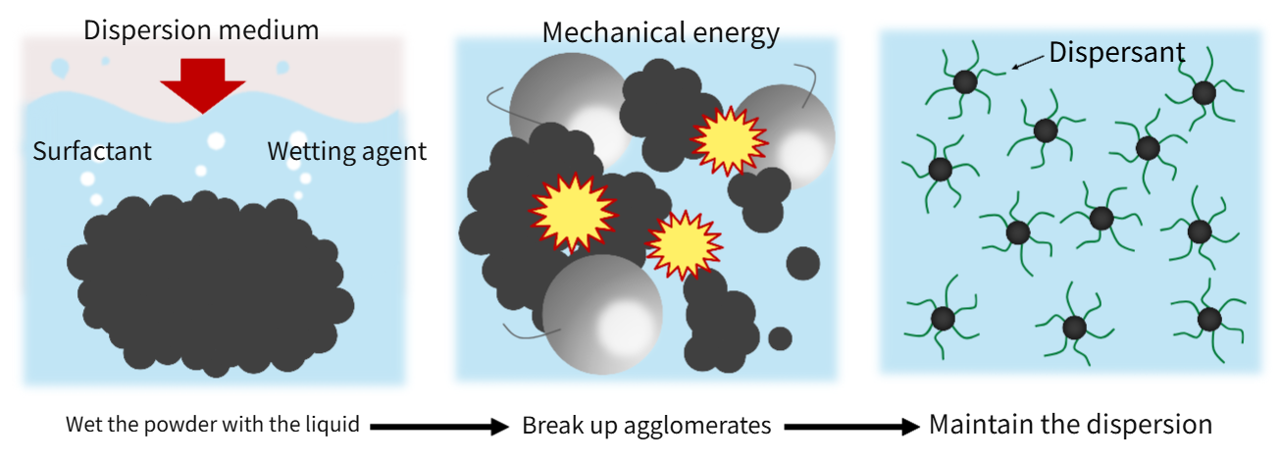
Figure1. Main stages of pigment dispersion
2. How Dispersion Is Stabilized
To understand how dispersants prevent re-agglomeration, it is useful to consider the interactions that arise as particles approach one another in a liquid. In practical terms, stabilization mechanisms can be grouped into electrostatic stabilization, steric stabilization, and combinations of the two [3,4].
Electrostatic stabilization is particularly important in aqueous systems. When adsorption of a dispersant introduces ionic groups onto a particle surface, the surface charge and surrounding counterions form an electrical double layer. Particles carrying charges of the same sign then repel one another as they approach. The magnitude and range of this repulsion depend strongly on conditions such as pH and salt concentration [4].
For polymeric dispersants, steric effects often become important. Portions of the adsorbed polymer chains extend into the surrounding medium and form a polymer-rich layer around the particle. This layer makes close approach between particles less favorable and can therefore stabilize the dispersion. The effectiveness of this mechanism depends not only on the chemical nature of the functional groups but also on parameters such as adsorption density, molecular weight, chain length, and molecular architecture [3].
In many practical formulations, electrostatic and steric contributions operate simultaneously. This is commonly referred to as electrosteric stabilization. Studies of model colloidal systems have shown that both surface charge and polymer layers can affect dispersion stability [4]. For real formulations as well, it is often more realistic to consider several stabilization mechanisms acting together rather than to assume that a single mechanism dominates.
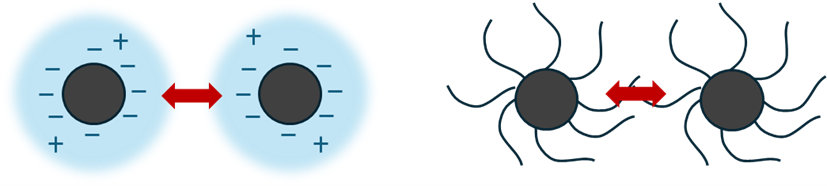
Figure2. Electrostatic stabilization (left) and steric stabilization (right)
3. Design Considerations for Polymeric Dispersants
A polymeric dispersant can be understood as a combination of molecular segments with different functions. One part interacts with and adsorbs onto the pigment surface, while another remains compatible with the surrounding dispersion medium and forms a protective layer around the particle. For convenience, these are referred to here as the anchoring segment and the medium-compatible segment, respectively.
The presence of an anchoring group alone does not determine dispersant performance. Relevant design variables include the strength of interaction between the anchoring segment and the pigment surface, the number and spatial arrangement of adsorption sites, the affinity of the medium-compatible segment for the solvent, the molecular weights of the respective segments, and the overall polymer architecture, such as linear, block, or comb structures.
These factors have also been examined experimentally. One study comparing potential anchoring chemistries for pigment dispersants demonstrated that selecting the anchoring functionality itself is an important design decision [5]. Another study investigated AB diblock, ABA triblock, and comb-shaped polymers for dispersing SiO2 particles in organic media. The results showed that the lengths and relative proportions of the anchoring and stabilizing chains, as well as the overall molecular architecture, strongly influenced dispersion performance [6]. Although the latter study focused on SiO2 particles rather than pigments, it provides useful insight into relationships between polymer architecture and dispersion behavior. In practice, suitable functional groups and molecular structures therefore need to be selected by considering both the surface chemistry of the target particles and the characteristics of the dispersion medium.
4. Example: Dispersion of Pigment Red 122
As a specific example, we consider a study comparing different functional groups in polymeric dispersants for Pigment Red 122 (PR122) [7]. PR122 is a representative quinacridone-based organic pigment and is widely used where strong color performance is required.
The study compared polymeric dispersants containing different anchoring functionalities. Among the chemistries tested, the dispersant containing a pyridine group provided better dispersion stability than corresponding dispersants containing phenyl, amino, or alkyl groups. Molecular dynamics simulations were also used to evaluate interactions between the dispersants and PR122. The ranking of the interaction energies obtained from the simulations agreed with the experimental trend.
This example illustrates that functional groups for a dispersant do not necessarily have to be selected solely through empirical trial and error. Interactions between the pigment surface and candidate dispersant structures can, at least to some extent, be evaluated quantitatively at the molecular level.
5. Using Simulation in Dispersant Design
One advantage of introducing simulation into dispersant design is that candidate molecules can be screened to some extent before experimental evaluation.
At the atomistic and molecular scale, molecular dynamics simulations can be used to compare adsorption configurations on pigment surfaces, interaction energies, and conformational changes of dispersant molecules in a solvent. First-principles calculations can provide an even more detailed description of adsorption at pigment surfaces by explicitly considering electronic structure. These approaches can help identify which functional groups or molecular structures are likely to contribute to stronger interactions with a particular pigment.
At a coarser scale, mean-field methods such as self-consistent field theory (SCFT) are useful for investigating the spatial distribution of polymer layers and polymer brushes. An SCFT study of interactions between colloidal particles and polymer brushes, for example, showed that the particle insertion free-energy profile depends on particle size and on polymer–particle and polymer–solvent interaction parameters [8]. Although this study did not directly address pigment dispersion, it provides useful insight into how polymer layers near a surface can influence the ability of particles to approach that surface.
At the mesoscale, particle-based methods such as dissipative particle dynamics (DPD) can coarse-grain both particles and the surrounding fluid. Such methods can be used to study aggregation and dispersion, the effects of shear flow, and hydrodynamic interactions. Reviews of DPD for colloidal and interfacial systems, as well as particle-dynamics approaches for colloidal suspensions, describe these methods as useful options for studying this class of dynamic behavior [9,10].
The Moving Particle Semi-implicit (MPS) method provides another particle-based approach. By accounting for interactions among particles in a suspension, it can be used to investigate how filler concentration and dispersion state affect viscosity. Such analyses can support the evaluation of dispersibility, slurry formulation, and optimization of coating processes [12].
In practical development, however, conclusions should not be based on simulation alone. Simulation results are most useful when considered together with experimental measurements such as particle-size distributions, viscosity, zeta potential, and adsorption amounts. Simulation is therefore best regarded not as a replacement for experiments, but as a tool for narrowing the range of candidate molecules and helping interpret experimental observations.
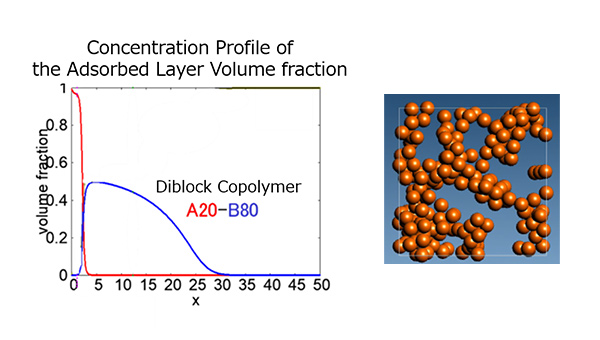
Figure3. Left: One-dimensional SCFT result for a diblock copolymer adsorbed on a fine-particle surface (x = 0 corresponds to the particle surface). Right: Particle-based simulation of the aggregation process of fine particles in a liquid.
6. Summary
Fine-particle dispersion is not simply a matter of mechanically reducing powder size. Wetting the particles with the dispersion medium, breaking down agglomerates, and stabilizing the resulting dispersed state must be treated as a connected design problem.
For pigment dispersions in particular, performance and storage stability depend strongly on how the part of a dispersant that interacts with the particle surface is combined with the part that remains compatible with the dispersion medium [1,3,5].
In recent years, experimental approaches have increasingly been complemented by computational methods such as molecular dynamics, SCFT, DPD, and other particle-based simulations. Together, these techniques provide information about pigment–dispersant–solvent interactions across different length and time scales [7–12].
To apply such a multiscale approach in practical materials development, it is useful to have an environment in which results obtained at different scales can be considered together rather than in isolation.
J-OCTA provides one platform for supporting this type of multiscale investigation. Please feel free to contact us if you are interested in applying these approaches to your materials or formulation challenges.
- C. Agbo, W. Jakpa, B. Sarkodie, A. Boakye, S. Fu, "A Review on the Mechanism of Pigment Dispersion," Journal of Dispersion Science and Technology 39, 874-889 (2018).
- S. Nagose, E. Rose, A. Joshi, "Study on wetting and dispersion of the Pigment Yellow 110," Progress in Organic Coatings 133, 55-60 (2019).
- S. Farrokhpay, "A review of polymeric dispersant stabilisation of titania pigment," Advances in Colloid and Interface Science 151, 24-32 (2009).
- G. Fritz, V. Schädler, N. Willenbacher, N. J. Wagner, "Electrosteric Stabilization of Colloidal Dispersions," Langmuir 18, 6381-6390 (2002).
- H. J. W. van den Haak, L.L.M. Krutzer, "Design of pigment dispersants for high-solids paint systems," Progress in Organic Coatings 43, 56-63 (2001).
- T. Fang, M. Huo, Z. Wan, H. Chen, L. Peng, L. Liu, J. Yuan, "Study of structure-performance relationships of polymeric dispersants on particle dispersion and stabilisation," RSC Advances 7, 2513-2519 (2017).
- H. Zeng, X. Fan, X. He, Z. Jiang, L. Niu, H. Yuan, "Influence of anchoring group of dispersants on the dispersion performance of Pigment Red 122," Dyes and Pigments 235, 112614 (2025).
- M. Y. Laktionov, O. V. Shavykin, F. A. M. Leermakers, E. B. Zhulina, O. V. Borisov, "Colloidal particles interacting with a polymer brush: a self-consistent field theory," Physical Chemistry Chemical Physics 24, 8463-8476 (2022).
- K. P. Santo, A. V. Neimark, "Dissipative particle dynamics simulations in colloid and interface science: a review," Advances in Colloid and Interface Science 298, 102545 (2021).
- D. S. Bolintineanu, G. S. Grest, J. B. Lechman, F. Pierce, S. J. Plimpton, P. R. Schunk, "Particle dynamics modeling methods for colloid suspensions," Computational Particle Mechanics 1, 321-356 (2014).
- JSOL, "Adsorption and Dispersion on Fine-Particle Surfaces Using Polymeric Dispersants," J-OCTA Analysis/Application Example [in Japanese].
- JSOL, "Viscosity of the suspension," J-OCTA Analysis/Application Example.
Related Information
Categories
New articles
- Fine-Particle and Pigment Dispersion: The Role of Simulation
- Adhesive and Pressure-Sensitive Adhesive Design with Multiscale Simulation
- Simulation of Coating-Film Drying : A Practical Introduction to 1D/3D Analysis for Coating, Painting, and Electrode Processes
- Designing Plastic Recycling with Molecular Simulation
- What is Materials Informatics (MI)?
Next-generation materials development accelerated by AI × simulation
- Electrical conduction as a multiscale simulation
- Development of force fields used in molecular dynamics calculation
- What you need to know when using molecular modeling and simulation for materials design
- Materials & Process Informatics
- Machine Learning for Materials Design in J-OCTA - - Simulation of lithium-ion batteries
